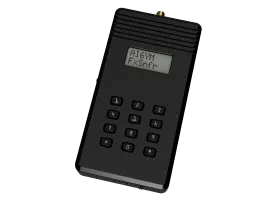
In the last chapter I showed you the r0 prototypepaperweight and all the various challenges with it. The next step was basically a complete
redesign.
This chapter covers the prototypes and tests between the r0 and r1 hardware versions. r1 is next
full prototype and will be covered in more detail in the next chapter.
Spoiler - I did eventually make a good receiver and shipped it! The r3 hardware is currently in
stock and on my store - you should buy one!
To refresh your memory - r0 didn’t have a real receiver, just a signal strength meter. Your feedback
told me that some use cases will require demodulating audio so I need a real receiver. (Software for
that feature is still under development.) Testing on the prototype showed that my board layout
leaked a lot of noise into the incoming signal, severely impairing sensitivity. The circuit I had
was essentially scrapped and I started again.
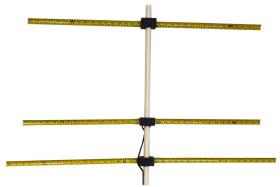
Some time last year I volunteered to make a tape measure Yagi-Uda antenna kit
for a club picnic. Of course I procrastinated and pulled the project together
at the last minute - but then I decided to pull together an entire product based
on that design. The kits launched at Pacificon this year and are now live on
my website.
August 8, 2026
r0 prototype, ugly and non-functional.
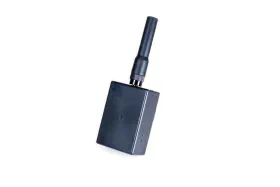
The FoxSniffer has finally shipped, all preorders are on their way, and I can finally take moment to
finish this post. This project has been almost two years in the making (and ended up about eight
months behind schedule).
The latest FoxSniffer design is in stock at the time of writing and available for sale on
my store.
I made this board because I kept having a simple problem - I had a header (or less) where I needed
a coax connection. The cost to make the board was nothing compared to the cost of shipping so I made
a bunch of extras. Back then there wasn’t much in my store so I added kits for $3 and fully
assembled boards for $4.
March 4, 2026
Figure 1: My thoughts on PHP and WordPress
You may have noticed I moved the store to Shopify
about a month ago. Now I’ve also moved the blog. This is a purely static site
rendered by Hugo, hosted on a server I manage. Let me know what you think.
tl;dr
Store is now on Shopify. Blog is now static and self-hosted. WordPress sucks.
For now there’s no comment system (I’m open to suggestions) and some content
hasn’t been moved yet - find it on the old blog for
now.
If the trivia of administering this project doesn’t interest you feel free to
stop reading now. The rest of this post is mostly me complaining.
This post was supposed to be short, just a quick update to say “I made a better
PicoFox”. It was supposed to be a marketing piece driving sales, expressing
gratitude to the community for great feedback, etc, etc, etc. What foolish
thoughts I had!
Instead this post is a 1,691 word discussion of dumb decisions and the
frustrations of engineering tradeoffs. Also, I made a better PicoFox.
September 13, 2025
Figure 1: Bits of cured urethane that were supposed to be buttons.
I was the type that hated showing my work in math class. Who cares how I got to the answer, it’s
correct isn’t it? Math always came easily to me so I’d often combine two or three steps in my head.
Being told to show my work felt like an arbitrary and meaningless requirement, or maybe an
accusation that I was cheating.
That’s not how I see things today. In my last post, The PicoFox Saga, I
showed my process. Dumb ideas, wrong turns, and outright failures; if I left anything out it was for
brevity. I did that while trying to market the PicoFox as a product. (I still am – you should
buy one.)
August 16, 2025
Figure 1: PicoFox r2 PCB up close.
Have you ever had an idea so spectacularly dumb you had to make it happen?
After seeing several SI5351 based transmitters for HF I had the idea that maybe this chip could be
pushed to do frequency modulation on VHF bands. It does glitchless frequency changes, it can generate
VHF clocks, it even claims a 0 PPM error. We all know that last part is nonsense but the error is so
low that we can pretend that it’s zero and just select an appropriate input oscillator.
This is a spectacularly dumb idea. There are a hundred better ways to implement frequency modulation
from simple analog circuits to full software defined radio. This is a middle ground that no one
asked for but the idea was just so tempting to me and I couldn’t find a single technical reason not
to do it.
I won’t bury the lede – I built the darn thing and it’s a great fox transmitter. Easy to configure
just by editing a text file, extra GPIO for adding external devices, open source hardware and
software so you can tinker to your heart’s content. It’s great, you should buy one. They’re in stock
and shipping right now.
August 2, 2025
QDX installed in its case with the battery and USB power supply.
The QRP-Labs QDX is a five band, five watt, digital mode HF transceiver. It’s highly efficient, easy
to operate, and configurable for bands from 2200 meter through 4 meter. As usual, Hans has created a
very clever bit of kit for the homebrew-minded ham.
For my QDX build I added a rechargeable LiPo battery pack, charge circuit, and a USB power supply. I
packed the build into an inexpensive extruded aluminum enclosure that I
sloppily machined for access to the various connectors. The result is a very lightweight and nearly
self contained digital rig that can be operated with nothing more than my iPhone and a simple wire
antenna.
July 19, 2025
Figure 1: Antennas don't work, but the sunset was pretty.
This year’s field day was an adventure. Great times were had by all but I could not have created
more technical difficulties if I had been trying for the record.
Let’s back up. After last year’s field day, fueled by excitement and more than a little hubris, I
volunteered to build and captain a VHF/UHF station this year. I’d seen some early success building
rotators and antennas for satellite operations. With nearly a year of prep time I knew I could build
an amazing station.